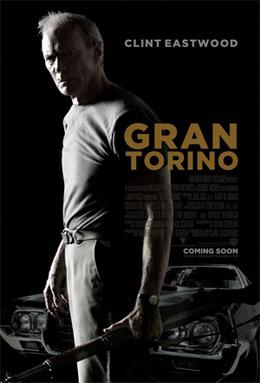
Starsky and Hutch drove a 1974 Ford Gran Torino, here a 1972 model is used to symbolise greatness in the American past. Clint Eastwood plays a recently widowed grumpy old man. His character Walt Kowalski (Walt Disney by way of Stanley Kowalski?) expresses disdain at the fact that his granddaughter openly wears a belly button ring at her grandmother's funeral with a broadly comic grunt.
This early expression suggests a lighter tone but it soon appears that this an examination of racial tensions like Crash but on a smaller scale. Kowalski openly espouses racial slurs and even does so casually with his Irish and Italian friends. After interrupting a transgression between his Hmong neighbours, Walt becomes a hero to them. The family's son Thao admits that he tried to steal Walt's prized Gran Torino and in restitution reluctantly agrees to do some chores for Walt. Walt his equally reluctant to take him on but does so and we soon have the classic dynamic of reluctant teacher and apprentice which Eastwood last did in Million Dollar Baby.
The story then plays out in textbook fashion until the final act when it returns to examining the racial tensions it had alluded to earlier in the film. Walt doesn't cease to be racist but gains some respect for his neighbours before embarking on a revenge mission akin to Travis Bickle's in Taxi Driver. There follows an unexpected ending which feels like a cop out designed to aid dramatic and emotional resonance and as a result made the film seem rather pointless. I'd question the politics of the film because, in lamenting the loss of an America and suggesting a return to those old white working class values, the film. despite itself appears racist. If only there was a white avenger to fix America.
This is a confused film which wouldn't work at all without the presence of Eastwood but ultimately it turns out to be a vanity project with Eastwood ending with eulogy for himself.


 Posts
Posts


No comments:
Post a Comment